


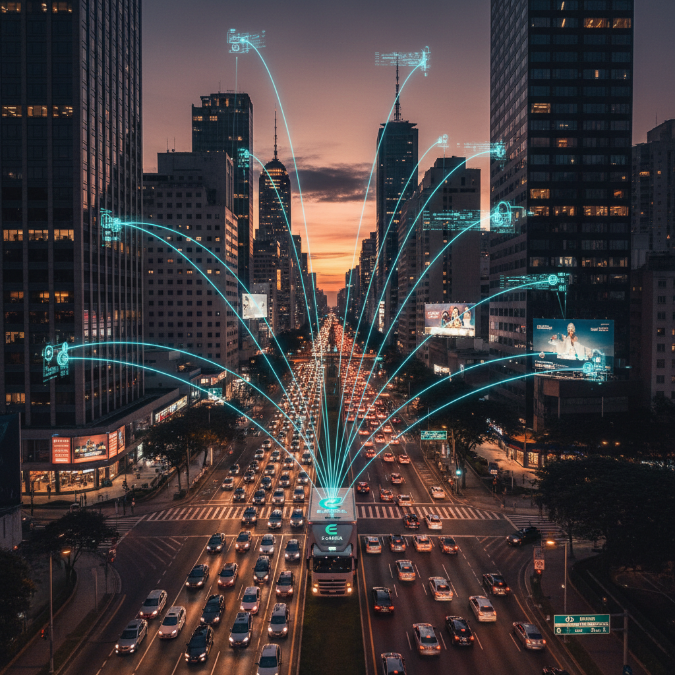
Brazil's massive continental size poses a unique challenge for the circular economy: logistics. Moving millions of tons of electronic waste from fragmented sources to industrial processing centers requires more than just trucks; it demands a sophisticated, data-driven network. The "First Mile" of collection is the most expensive and complex part of the chain, acting as a high barrier to entry for competitors.
Successful operators like Ecobraz are solving this puzzle by treating reverse logistics as a technology problem. By using digital scheduling, route optimization, and a hub-and-spoke model, they are turning Brazil's geographic challenges into a competitive moat. This efficiency is critical for unlocking the economic value of e-waste and ensuring that materials are actually recycled rather than lost in transit.
For global investors, the Brazilian logistics sector for waste offers a scalable infrastructure play. As the world moves toward "Urban Mining," the networks established today to move these materials will become the strategic supply lines of the future, supporting everything from consumer electronics to the burgeoning EV battery market.
By Editorial Staff | Ecobraz Informa
Why the battle for the circular economy will be won or lost on the road. An analysis of the infrastructure, technology, and operational density required to move millions of tons of e-waste.
In the world of logistics, Brazil is not just a country; it is a continent disguised as a nation. Spanning over 8.5 million square kilometers, it is larger than the contiguous United States and nearly twice the size of the European Union. For the supply chain manager, this geography presents a formidable adversary. The infrastructure varies wildly from the industrialized highways of São Paulo to the river-dependent transport of the Amazon basin. Yet, electronic waste is ubiquitous, present in every corner where a smartphone signal reaches.
For international investors analyzing the potential of the Brazilian recycling market, the primary question should not be "is there enough waste?"—we know there is. The critical question is: "How do we move it?" In traditional "forward" logistics (factory to consumer), the path is linear and predictable. In reverse logistics (consumer to recycler), the path is chaotic, fragmented, and geographically dispersed. Solving this "many-to-one" collection problem is the hardest hurdle in the circular economy.
This logistical barrier effectively acts as a "moat" for incumbents. Small, local scrap dealers cannot achieve the economies of scale required to transport low-density e-waste over long distances without eroding their margins. Only operators with sophisticated fleet management, route optimization algorithms, and strategic consolidation points can turn this logistical nightmare into a profitable network.
The unit economics of recycling are dictated by transport costs. A ton of old printers in a warehouse in Rio de Janeiro is an asset; that same ton dispersed across 5,000 households is a liability. The cost to collect (the "First Mile") can easily exceed the value of the recovered materials if not managed with surgical precision.
Successful operators in Brazil are rewriting the playbook on collection density. They are moving away from passive collection points (drop-off boxes that often remain empty or contaminated) toward active, data-driven collection strategies. This involves B2B partnerships where large volumes are aggregated at corporate headquarters, government offices, and schools before a truck is ever dispatched.
Companies like Ecobraz have recognized that logistics is actually an information problem. By utilizing digital scheduling platforms and establishing predictable collection routes, they minimize "empty miles"—the bane of transport efficiency. This approach allows for the aggregation of volume essential for industrial processing, transforming sporadic waste flows into a steady stream of raw materials.
Foreign investors often cite the "Custo Brasil" (Brazil Cost)—a mix of high taxes, bureaucracy, and infrastructure bottlenecks—as a deterrent. However, in the niche of specialized logistics, these challenges filter out weak competition. The regulatory requirement for hazardous waste transport (which includes many electronic components) is strict. Vehicles must be licensed, drivers trained for hazardous materials (MOPP), and routes often require specific permits.
This regulatory friction means that a standard courier company cannot simply pivot to e-waste. It requires a specialized fleet and a compliance-first operational culture. The players who have navigated this bureaucracy and built compliant fleets hold a significant strategic advantage. They have effectively built a pipeline that connects the urban centers of South America to the global commodities market.
Furthermore, the reverse logistics sector is innovating to bypass traditional bottlenecks. We are seeing the rise of "micro-hubs" in urban centers—small consolidation facilities that allow smaller vehicles to collect waste in dense city traffic, which is then transferred to larger trucks for interstate transport. This hub-and-spoke model is crucial for navigating megacities like São Paulo, which has a metropolitan population of over 22 million.
It is impossible to discuss modern logistics without discussing software. The scalability of the Brazilian e-waste sector relies on the "Uberization" of collection where appropriate, and enterprise resource planning (ERP) for corporate clients. Real-time tracking is not just a security feature; it is an efficiency tool.
The integration of the consumer interface with the logistical backend is key. When a company schedules a pickup via a platform like Ecobraz’s system, that data point triggers a chain of events: route calculation, volume estimation, and warehouse space allocation. This digital integration reduces the friction that typically discourages recycling. If it is easy to schedule, companies will do it. If it is difficult, the waste sits in storage, depreciating.
For the investor, the value lies in the platform. A company that owns the customer relationship through a digital interface, and executes the physical movement through an optimized network, is building an asset that scales much faster than a traditional scrap yard. It is a tech-enabled logistics play, operating in a sector with guaranteed growth.
Global supply chains are fragile, as recent years have demonstrated. There is a growing movement toward "nearshoring" and regional self-sufficiency. By building a robust reverse logistics network in Brazil, the country positions itself not just as a consumer of technology, but as a supplier of secondary raw materials for the Western hemisphere.
This network is the "railroad" of the 21st century. Instead of moving coal and timber, it moves copper, gold, and plastics. The companies laying these tracks today are securing the rights to move the materials of tomorrow. As electric vehicle adoption grows, the logistics network built for e-waste will naturally evolve to handle EV battery recycling—a market projected to dwarf consumer electronics in volume and value.
In the Brazilian market, scale is the primary hedge against risk. A small operator is vulnerable to commodity price fluctuations. A large, logistics-driven operator captures margin through efficiency and volume. The opportunity for international capital is to fuel this expansion—to take proven regional models and scale them nationally.
The "Continental Puzzle" of Brazil is being solved by operators who understand that a truck is not just a vehicle, but a data node in a massive, distributed mining operation. For those looking to invest in the circular economy, look for the companies that have mastered the road. They are the ones who will deliver the returns.


